
Does this aim to re justify the architect title and meaning?
Normally, I have a great deal of respect for the RIBA. I have completed two RIBA-accredited degrees, achieved a Master’s degree in architecture, and spent a few years within a system that teaches you to take the built environment seriously. That is probably why the current debate around the “protection of function” for architects feels so important, and also why it feels uncomfortable.
The RIBA is now calling for a new regulatory approach to architectural work in the UK, based around what it describes as a competence-led model. In simple terms, the proposal moves beyond protecting the title of “architect” and instead looks at whether certain activities, such as submitting full planning applications, building control applications, and final compliance certificates, should become reserved activities for suitably competent professionals. The RIBA also proposes replacing the current Architects Act framework with new legislation and a wider built environment oversight model.
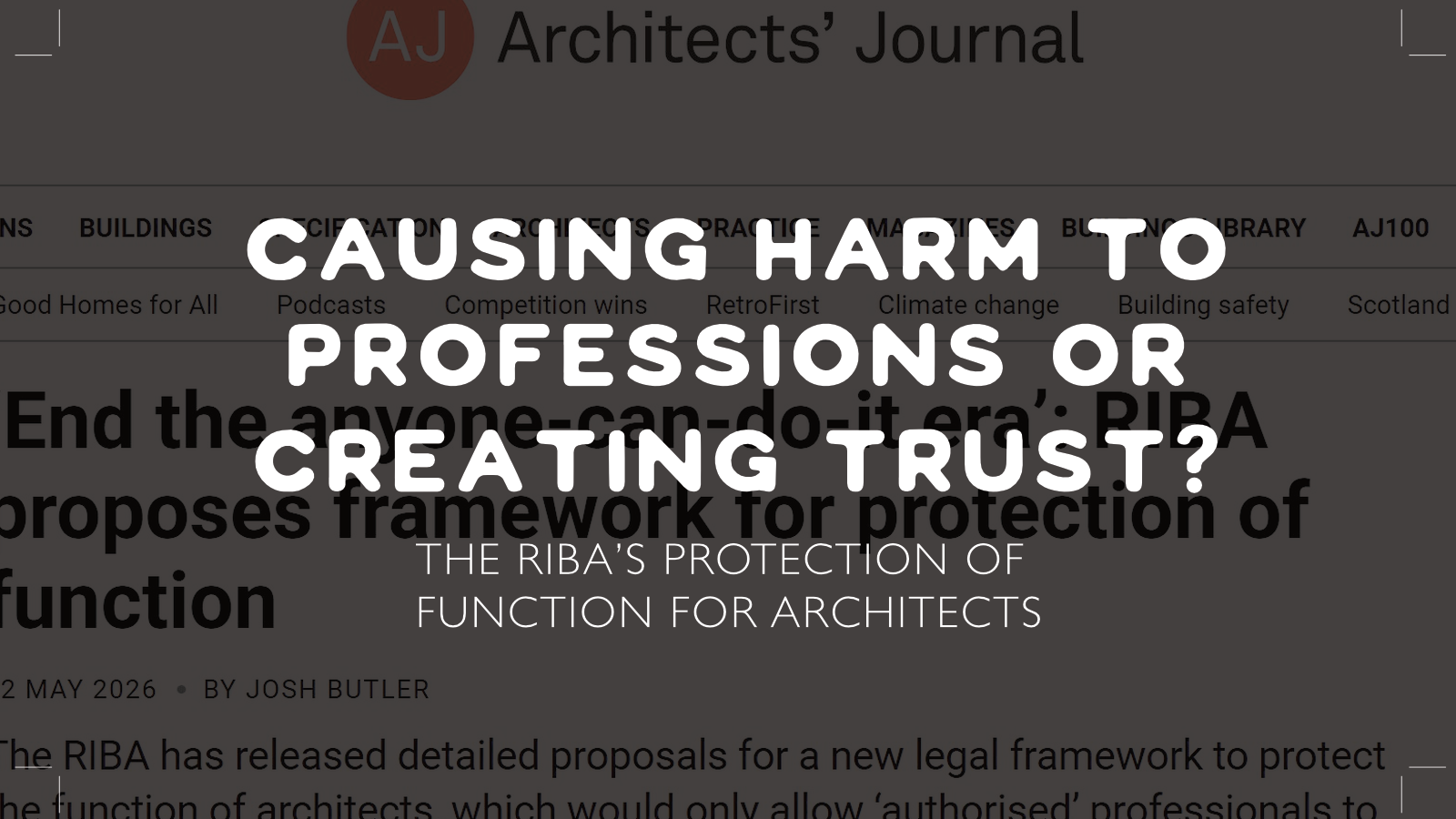
On paper, that sounds reasonable. Public safety, competence, accountability, and quality are all things the construction industry should be taking seriously, especially after the failures exposed by the Grenfell Tower Inquiry and the wider building safety debate. The question, though, is whether this proposal genuinely improves public protection, or whether it risks becoming a late attempt to reclaim territory in an industry that has already changed. This is mainly coming off the back of the AJ journal article which was marked as subscriber only for something that impacts the whole industry. So I can only gather the content from reactions online and other articles including the main source of the RIBA.
The title “architect” is not the whole industry
The current system protects the title “architect”, but not every function commonly associated with architectural work. That means someone cannot simply call themselves an architect without being registered, but many forms of design, planning, technical coordination, and project support are already carried out by a much wider group of built environment professionals.
That is not a loophole in some distant corner of the industry. It is how much of the industry already works.
Planning consultants submit planning applications. Architectural technologists and technicians often handle technical design and building control information. Architectural assistants, designers, project runners, and consultants all contribute to work that the public may loosely describe as “architecture”, even when a registered architect is not the only person doing the work.
This is why the proposal becomes complicated. It is not simply about whether architects are valuable, because they clearly are. It is about whether reserving certain functions now would improve outcomes, or whether it would disrupt an already established ecosystem of competent professionals who are not all architects.
Who is this really for?
The strongest version of the RIBA’s argument is that the public deserves buildings shaped by competent, insured, accountable professionals. I agree with that principle completely. I would happily work within a clearer competence-led framework if it applied fairly across the industry and measured people against what they actually do, not simply the title they hold.
As an architectural designer, I still try to follow many of the principles associated with architectural practice. That includes acting with care, being honest about competence, taking insurance seriously, and treating residential work as something that affects people’s lives rather than just a set of drawings.
I have also been told before that, as an architectural designer, I have no formal obligation to hold myself to certain professional expectations in the same way a registered architect might. That may be true in a narrow sense, but it does not sit comfortably with me. If you are designing homes, advising clients, preparing information, and influencing the built environment, then ethics and competence should not be optional extras.
The real question is whether the answer to that problem is to strengthen competence across the sector, or to narrow key activities around one professional identity.
Planning applications feel like a strange place to draw the line
One of the areas that seems to have caused the most reaction is the idea that full planning applications could become a reserved activity. This is where I think the debate becomes especially messy.
Planning is important, but it is not the same as detailed technical design or construction sign-off. A planning application often sits early in the project timeline, before the building has entered construction and before many technical decisions have been fully developed. It carries risk, of course, but it is a different kind of risk from the risks involved in detailed building control work, fire strategy, structural coordination, or compliance on site.
It is also already an area where many other professionals operate. Town planners, planning consultants, urban designers, architectural technologists, and experienced designers all play substantial roles in shaping, preparing, and submitting planning information.
That is why some of the reaction from planners and other professionals has been sharp. One comment I saw online made the point rather neatly: if architects argue that only they are qualified enough to submit planning applications, a planner could just as easily argue that architects are not qualified enough to do the same from a planning perspective.
That might be a slightly cheeky argument, but it exposes the problem. Once professional groups start drawing lines around functions, every discipline can make a case for why their expertise should control part of the process.
Competence should matter more than professional territory
The built environment does not improve because one title wins a regulatory argument. It improves when competent people do work they are actually capable of doing, and when clients can understand who is responsible for what.
That is where I think the debate should be heading. Not towards a simple architects versus non-architects divide, but towards clearer standards of competence, better transparency, suitable insurance, and realistic accountability across the whole project team. I tried to approach the RIBA for questions over the level of cover for PI for myself and they simply didn’t want to help or provide guidance. Thankfully the ARB where, although I’m not qualified they were able to give guidance and standards they would expect from Architects as their best advice.
A chartered architect may be the right person for a project. So might a chartered architectural technologist, a planning consultant, an architectural designer with strong residential experience, or a properly coordinated team of several professionals.
The project should dictate the competence required, rather than the industry trying to force every project through a single professional doorway.
Has the architect become a public-facing title?
This is the part of the debate that architects may not enjoy, but I think it is worth asking.
Has the architect, in some sectors, become more of a public-facing title than the sole driver of the work? I sometimes refer to them as ‘tv architects’
In many practices, the work that leaves the office is produced by a mixture of people. Part 1 and Part 2 architectural assistants, technologists, technicians, designers, project architects, directors, consultants, and administrators all contribute to the process. The architect may carry responsibility, lead the design, or oversee the work, but architecture as a service is often a team effort.
That does not diminish the role of the architect. It simply reflects reality.
For the general public, especially in small residential work, the distinction is often even less clear. Many homeowners do not know who produced the drawings, who submitted the planning application, or whether the person they spoke to was an architect, designer, technologist, assistant, or director. In many cases, they simply want someone who can understand the brief, explain the process, and help them improve their home.
That gap between professional identity and public understanding is exactly where this debate becomes difficult.
The residential sector needs affordability as well as quality
From my perspective, architectural designers often provide a more approachable and affordable route into residential design. That matters, particularly for homeowners who are not building luxury houses but simply trying to improve the way they live.
I think many architects forget architecture is a luxury product, there are countless items where the architect cannot provide valuable input because it’s just not econmical. If regulation makes small residential work more expensive without clearly improving outcomes, then it may reduce access to design rather than improve it. That would be a problem.
Good residential design should not become something only available to clients with large budgets. Extensions, conversions, internal reconfigurations, garden rooms, and modest new homes all benefit from design thinking, but they also need services that feel realistic for ordinary people.
That does not mean standards should be low. It means the route to competence needs to be proportionate.
Grenfell should not become a professional marketing tool
This is the most sensitive part of the conversation, so it needs to be handled with some sensitivity and care.
The Grenfell Tower fire exposed deep failures across procurement, regulation, product testing, accountability, construction culture, and professional responsibility. It should force every part of the built environment sector to think seriously about competence and public safety.
What makes me uneasy is when Grenfell becomes a rhetorical shortcut for one profession to strengthen its own position. Public safety should not be used as a decorative shield for professional protectionism. If the argument is genuinely about safety, then it needs to apply across the whole chain of responsibility, not just the parts that help one professional body regain influence.
That does not mean the RIBA’s concerns are automatically wrong. It means the reasoning needs to be tested carefully, especially where proposed reserved activities overlap with work already carried out by other competent professionals. Proposals to raise standards across the board would be more welcomed such as a unified design certification process for project stages.
The industry has already diversified
One of the challenges for the RIBA is that the industry has already moved on. The old idea of the architect as the single controlling professional across every part of a project does not reflect how many projects now operate.
Planning consultants, technologists, interior designers, project managers, contractors, energy consultants, heritage consultants, fire consultants, engineers, landscape architects, and architectural designers all sit within the built environment. Some projects need all of them. Others need only a few.
So when the RIBA proposes reserving functions, the question becomes: who gets included, who gets excluded, and how is competence judged? Does that exclude any none chartered members or professions such interior designer or urban designers from planning applications?
The RIBA’s own position does acknowledge that other chartered professionals may be competent to carry out some of the proposed reserved activities, including chartered planners for planning applications and chartered engineers for building control applications. That is an important distinction, because the debate should not be reduced to “architects only” if the stated aim is competence.
Even so, many people outside the architect title will be watching closely, because any new framework could reshape who is allowed to do what.
So, is this about saving the profession or protecting the public?
The honest answer is that it may be both.
The architectural profession has real issues. The title is protected, but the value of that title is not always understood by the public nor is it sometimes not respected in the industry. Fees are under pressure, routes to qualification are long and expensive, and many people doing architectural work sit outside the traditional architect label.
It is understandable that architects want stronger recognition for the responsibility they carry. It is also understandable that architectural designers, technologists, planners, and others are wary of a reform that could restrict work they already do competently. I know a lot of Studios who fly the flag as architectural designers, would they be forced to close?
That is why the outcome matters.
A good version of this reform would raise standards across the built environment, recognise different forms of competence, protect the public, make responsibilities clearer, set standards for PI and increase access to the industry. A bad version would simply narrow the market, increase costs, and use public safety language to protect professional territory.
Final thoughts
I do not think this debate should be reduced to architects versus architectural designers, or RIBA versus everyone else. That is too simple, and the industry is far too complex for that especially with AI on the horizon.
The real question is whether the built environment needs clearer competence standards. I think it does. The next question is whether reserved activities are the best way to achieve that. I am less convinced, especially if the system risks excluding professionals who already carry out valuable work with appropriate insurance, knowledge, and care.
If applications are being approved, projects are being signed off, and clients are receiving competent support, then the measure of progress should not simply be whether the person involved holds one particular title. It should be whether they are properly skilled, properly insured, transparent about their role, and working in the public interest.
So, is the RIBA’s protection of function a bid to save the profession, or a way to gatekeep the industry?
That depends on what happens next.
If it becomes a fair competence-led framework that recognises the wider industry, it could be useful. If it becomes a defensive move to protect professional territory, it risks creating more division than progress.
And the public, who this is supposedly meant to protect, may still be left wondering what any of us actually do.
Link to the RIBA article.
Cover image item base from the AJ Journals Article.
https://www.riba.org/campaigns/competence-led-approach-to-architects-regulation
Leave a Reply